

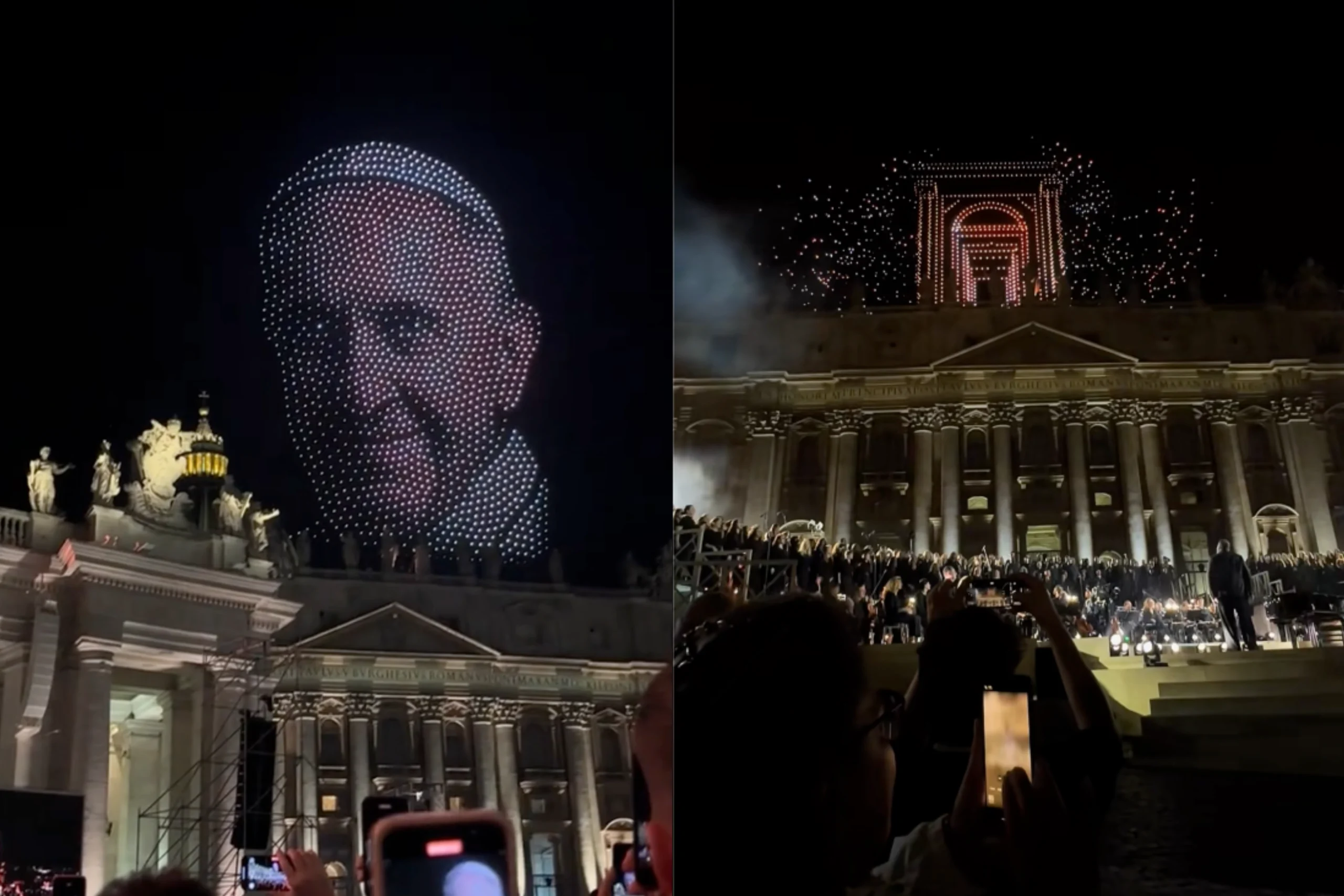
On Saturday, 13 September 2025, St Peter’s Square in the Vatican became the stage for a historic moment: the Grace for the World concert, the closing event of the third World Meeting on Human Fraternity. The free event, conceived by the Fratelli Tutti Foundation in partnership with St Peter’s Basilica, was directed by Andrea Bocelli and Pharrell Williams, and brought together a programme that blended musical excellence, faith, and powerful visual symbolism.
The motivation behind Grace for the World was clear: to promote global fraternity, foster unity among religions, cultures and generations, and to demonstrate that, in times of social polarisation, ideological division and multifaceted crises, it is still possible to build bridges through art. The gathering of leaders, activists, artists and the public reflected a collective desire for symbolic reconstruction — to “reconnect” the world through beauty, compassion and shared values.
Artists from diverse backgrounds took part. Among them was Karol G, who made history as one of the first Latin artists to perform at an event of such magnitude at the Vatican, adapting her repertoire with gospel and spiritual inspiration. Angélique Kidjo, with her vibrant voice, fused African rhythms with a message of hope. John Legend, Jennifer Hudson, BamBam, Jelly Roll, the Voices of Fire choir, Andrea Bocelli and Teddy Swims also graced the stage with performances that intertwined tradition and contemporaneity.
One of the most striking images of the evening was the drone spectacle: more than 3,000 drones lit up the Roman sky above St Peter’s Basilica, creating visual projections such as the face of Pope Francis, Michelangelo’s Pietà, the Creation of Adam, and doves of peace — symbols deeply infused with spirituality and artistic heritage. The audience, estimated between 80,000 and 300,000 people (figures vary depending on sources), experienced a moment that combined sacredness, emotion and cutting-edge technology.
Beyond the music and the visual spectacle, Grace for the World was embedded in a wider context of reflection: at least fifteen round tables and dialogues were held over the two days of the meeting, with participants from different fields — academics, activists, religious leaders, and experts in technology, economics and the environment. Discussions focused on themes such as justice, peace, freedom, ethical technology, and practical fraternity.
The impact of this event goes beyond symbolism. It reinforced the role of art and music as tools for social engagement, offering recognition opportunities for artists from marginalised or underrepresented cultures on global stages. It may also positively influence cultural tourism, the international perception of the Church under the pontificate of Pope Leo XIV, and spark dialogues about the ethics of technology (such as the use of drones) and its intersection with long-standing traditions. For the business world, Grace for the World stands as an example of how major cultural productions can mobilise mass audiences, foster institutional cooperation, and inspire models of “purpose-driven experiences”, where symbolic values and social branding take centre stage.
In summary, Grace for the World was not merely a concert: it was a cultural statement of faith, a demonstration that music and spirituality still hold both symbolic and real power for transformation. And for the worlds of luxury, the arts, and business that observed, the lesson is clear: creating something that resonates with the collective spirit is perhaps the most refined form of luxury there is — because meaning today is as precious as aesthetics.


