

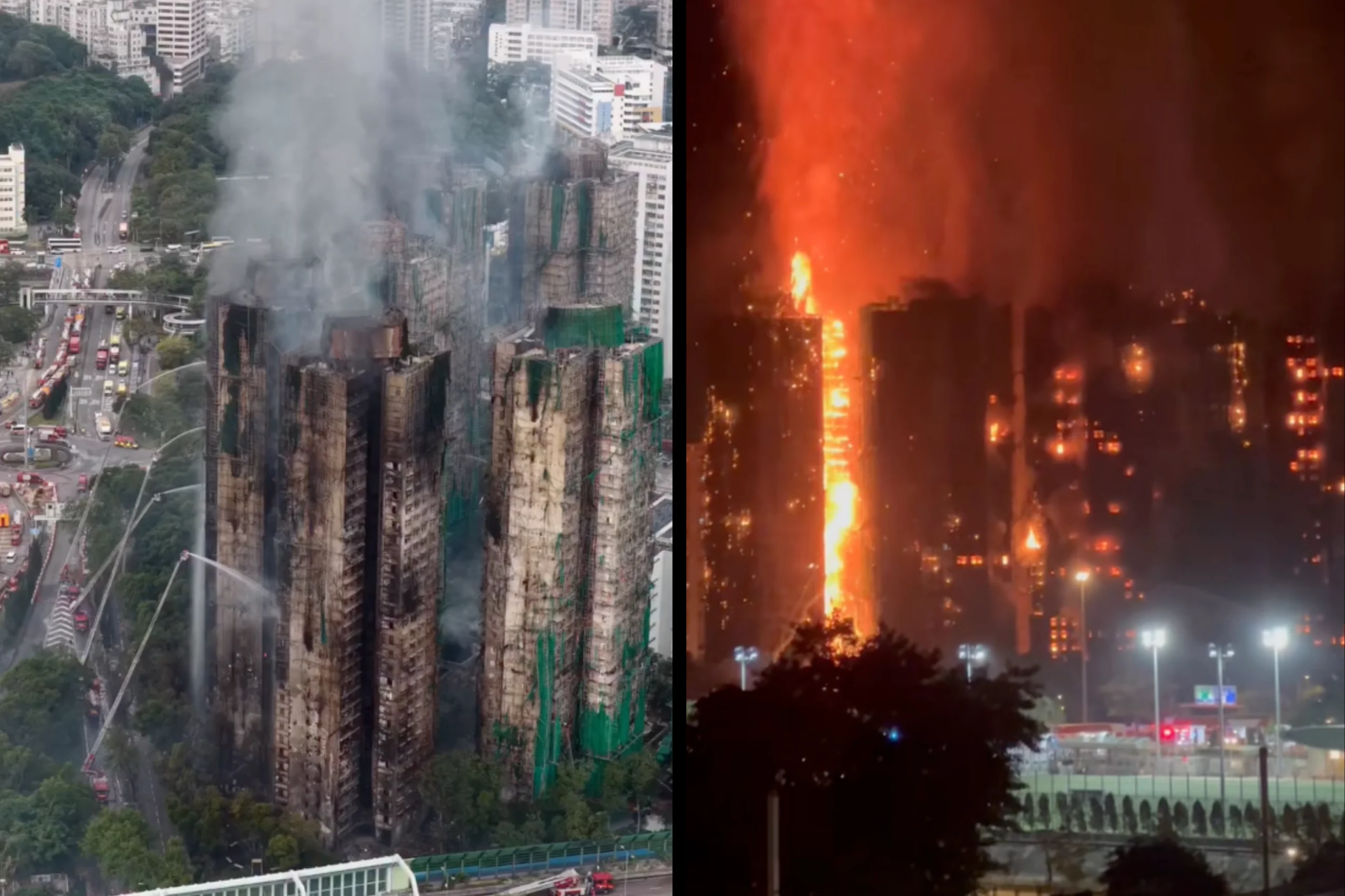
On the afternoon of 26 November 2025, a catastrophic blaze engulfed a cluster of residential towers in the Tai Po district of Hong Kong — the Wang Fuk Court complex, comprising eight 32-storey buildings. The flames spread with alarming speed, turning homes and an entire community into ruins.
The consequences were devastating: the official death toll reached 128, with around 200 people still missing — one of the worst urban disasters in Hong Kong’s recent history. Dozens more were injured with burns and smoke inhalation, and many families were left homeless — with approximately 900 residents relocated to temporary shelters.
What made the tragedy worse
Authorities identified several factors that intensified the disaster: the use of bamboo scaffolding and a green protective mesh, both highly flammable materials that accelerated the spread of the fire. The building was undergoing renovation, which increased its vulnerability.
Sources also reported a failure of the fire alarm systems — many did not activate, delaying both rescue efforts and evacuation. Moreover, plastic foam cladding on window frames and exterior panels intensified the fire’s spread along the facades.
The situation worsened with the partial collapse of scaffolding and the dense smoke, which hindered rescuers’ access to the upper floors. The operation lasted more than 40 hours until the flames were brought under control and rescue efforts officially concluded. AP News.
Justice and accountability
Within 48 hours of the incident, authorities arrested eight individuals — directors and consultants from the company responsible for the construction and maintenance, Prestige Construction & Engineering Company — on charges of gross negligence and involuntary manslaughter. Documents, computers and building plans were seized as part of the investigation.
The Hong Kong government has pledged a HK$300 million support fund to assist affected families. Reuters.
The disaster has also sparked intense debate about local construction safety standards, the use of flammable materials and regulations surrounding renovation works in high-rise buildings — issues that the public and authorities are expected to scrutinise closely in the coming weeks. The Guardian.
Global repercussions and reflection
Beyond the local tragedy, the fire has re-ignited discussions about the vulnerabilities of densely populated urban centres. International media have compared the event to the infamous Grenfell Tower fire in London (2017), highlighting that neglect of housing safety and building regulations can lead to devastating consequences — regardless of the country.
The episode exposes urgent dilemmas that combine urban planning, social inequality and governance:
How many lives depend on regulations that are often ignored in the name of cost-cutting or efficiency?
How many homes are at the mercy of cheap, unsafe materials due to pressure from the property market?
This fire is not merely an isolated tragedy: it is an urgent call for collective responsibility. It reminds us that the foundations of a city — both literal and symbolic — must be built with care, safety and humanity.


